

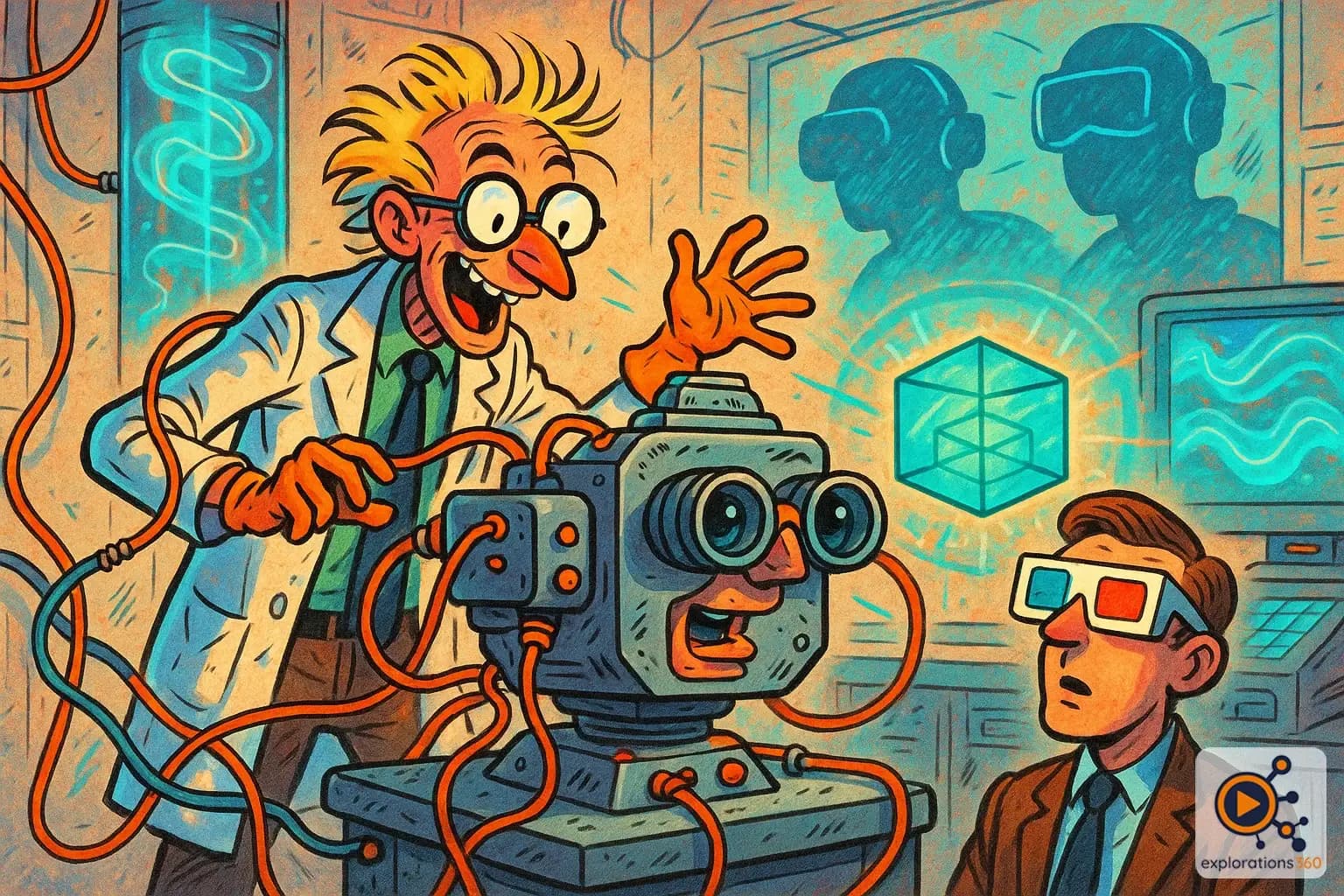
Explanation
A technique that creates the perception of depth by presenting two slightly different images, one to each eye.
Real-world example
The principle behind 3D glasses: each eye sees a slightly offset image, and the brain fuses them into a single picture with depth.
Practical applications
- Depth perception: seeing the true distances of virtual objects
- Precise manipulation: estimating size and position to grasp objects accurately
- Architecture: evaluating volumes and proportions at full scale
- Medical: visualizing anatomy in true 3D relief
Stereoscopic techniques
Active stereo
- Rapid alternation of left/right images
- Synchronized shutter glasses
- High image quality
- Used in CAVEs and some cinemas
Example: Nvidia 3D Vision glasses for compatible displays
Passive stereo
- Two simultaneously displayed images with different polarization
- Simple, lightweight polarized glasses
- Less flickering
- Standard in 3D cinemas (RealD)
Example: 3D glasses at an IMAX cinema
VR headsets (stereo by design)
- One screen/lens per eye
- No additional glasses needed
- Adjustable IPD to match the user's eyes
- Perfect stereoscopy with no compromise
Example: The two lenses in a VR headset that isolate each eye's view
VR scenario
A surgeon trains for an operation in VR. Stereoscopy allows them to perceive exact depth: they can see that the artery is 2 cm behind the tissue, not 5. Without this faithful 3D vision, it would be impossible to develop the muscle memory for the correct gestures. This is why traditional 2D monitors cannot replace VR for this type of training.
Why it matters in professional VR
- Natural perception: our vision is stereoscopic, so VR must be too
- Spatial accuracy: essential for manipulation tasks
- Error reduction: better perception means better actions
- Limitation of mono 360 videos: the absence of stereo limits immersion