

Explanation
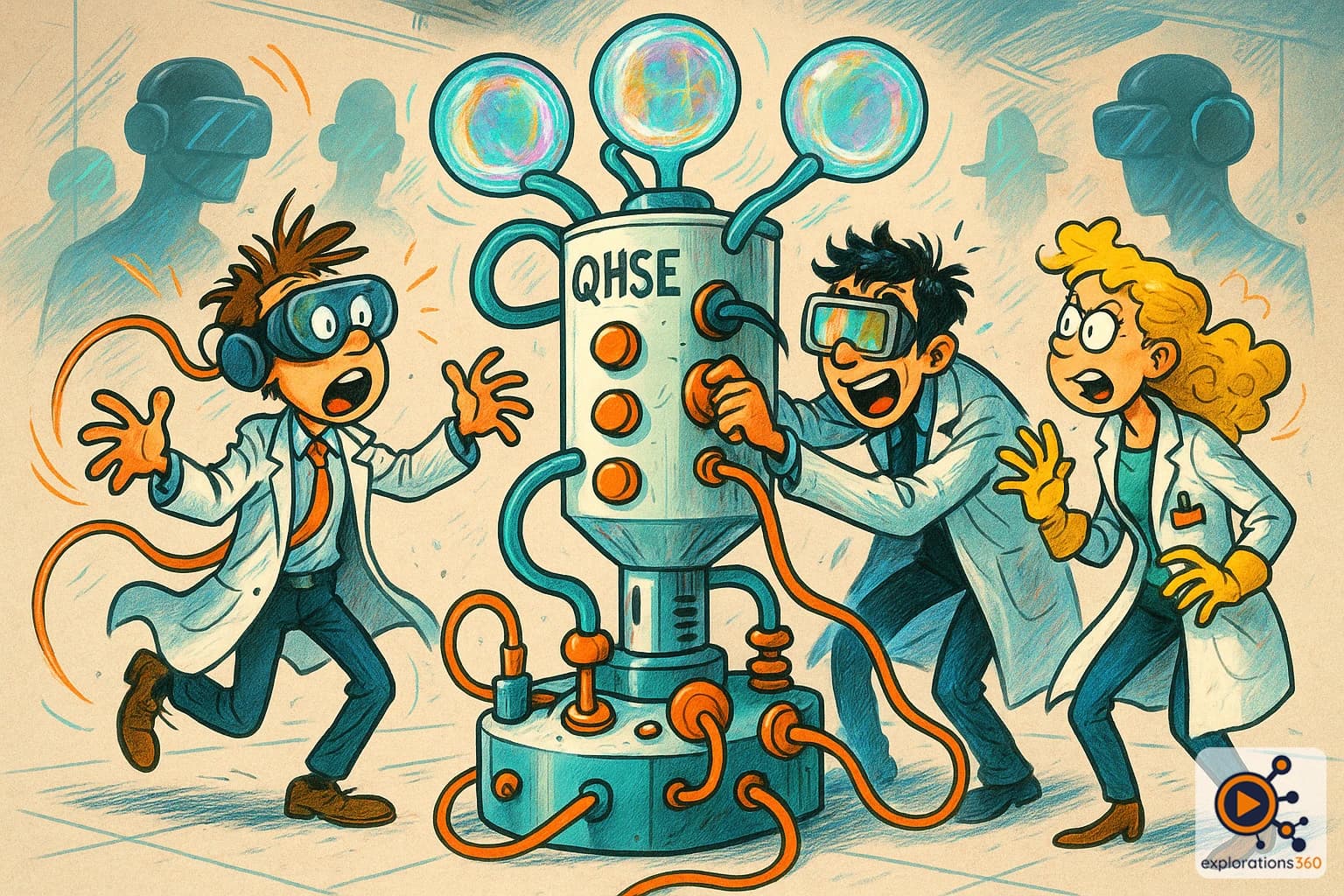
QHSE encompasses four pillars of enterprise risk management and compliance: process Quality, workplace Health and hygiene, personnel and facility Safety, and Environmental protection. In the immersive context, VR and 360° are powerful tools for training employees on QHSE procedures, simulating hazardous situations, and evaluating reflexes without real-world danger.
Real-world example
Fire safety instructions posted in your office, kitchen hygiene protocols, mandatory hard hats on a construction site -- all of this falls under QHSE.
Practical applications
- Training operators on safety procedures in VR without real-world hazard exposure
- Simulating an industrial accident or fire to evaluate evacuation reflexes
- Creating 360° virtual tours of facilities for remote QHSE audits
- Assessing employee knowledge through interactive immersive scenarios with scoring
The 4 pillars of QHSE in the immersive context
Safety and risk prevention
- Simulating accidents and incidents without real-world danger
- Training on emergency procedures (evacuation, first aid)
- Identifying on-site risks via annotated virtual tours
- Evaluating employee reflexes in critical situations
Example: A VR module that simulates a gas leak in a chemical plant to train operators on the correct response
Quality and compliance
- Training on quality procedures through step-by-step immersive walkthroughs
- Virtual auditing of facilities with 360° photographic documentation
- Standardizing best practices through reproducible scenarios
- Training and assessment traceability for certification
Example: A quality auditor tours a factory in 360° from their desk and checks workstation compliance
VR scenario
An industrial group uses VR to train its 2,000 operators on QHSE procedures. Every new employee follows an immersive program: a 360° virtual site tour identifying risk zones, an accident simulation to test reflexes, then an interactive assessment with scoring. Results automatically feed into the QHSE training register. The accident rate dropped 40% within one year.
Why it matters in professional VR
- QHSE training in VR is one of the most mature and profitable use cases for virtual reality
- Immersive simulation enables training for dangerous situations that are impossible to reproduce in real conditions
- 360° virtual tours facilitate remote audits and facility documentation
- Immersive training traceability meets ISO certification and regulatory compliance requirements