

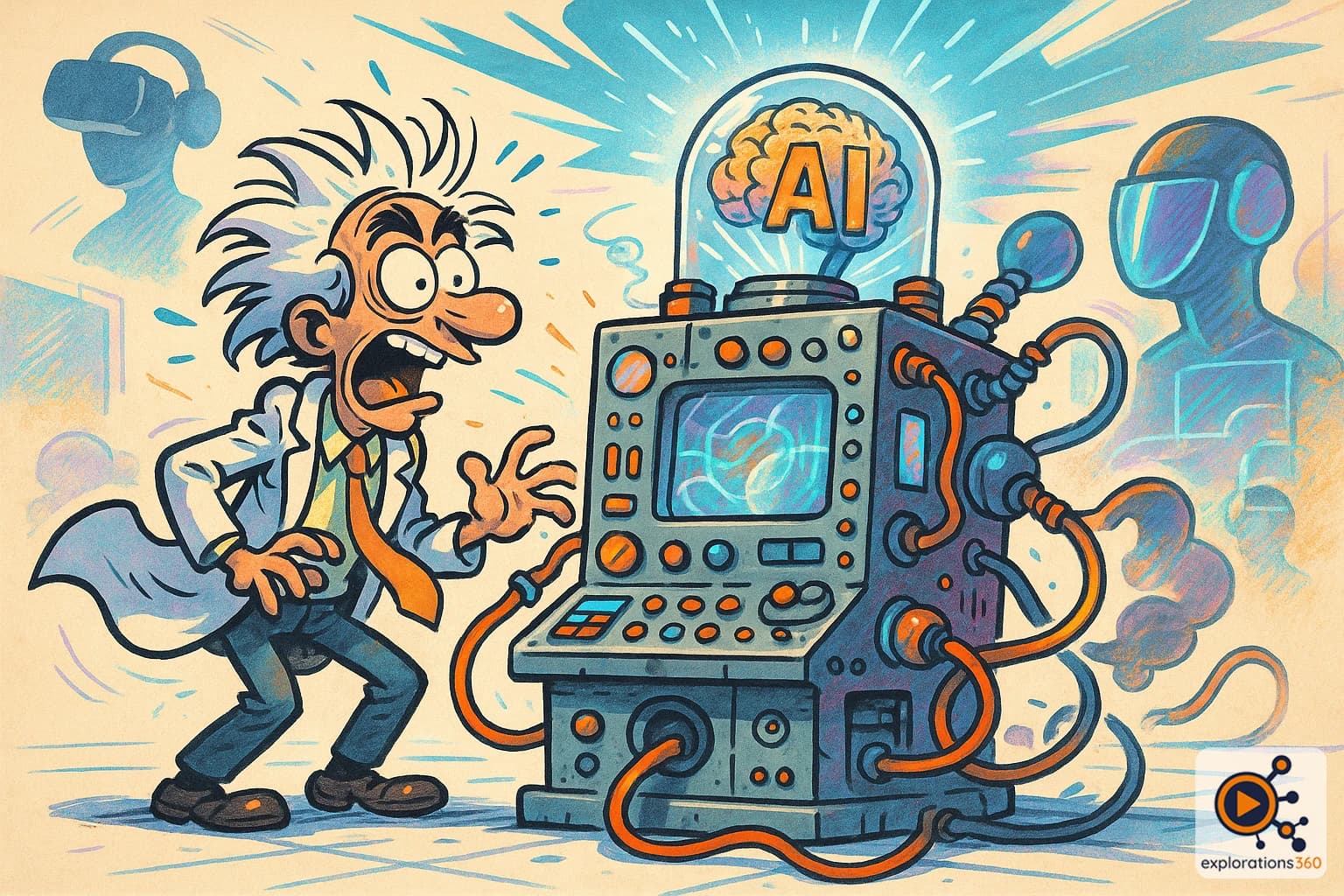
Explanation
Artificial intelligence (AI) encompasses all techniques and algorithms that enable machines to analyze, learn, and make decisions autonomously. In immersive contexts, AI enhances VR/360° experiences by automating content creation, personalizing training paths, analyzing user behavior, and making virtual environments more realistic and interactive.
Real-world example
When your phone recognizes faces in your photos, when a voice assistant understands your question, or when Netflix recommends a movie — that is artificial intelligence at work.
Practical applications
- Automatically generating 3D environments and textures from text descriptions
- Personalizing VR training paths by adapting content to the level and pace of each learner
- Analyzing eye tracking and 360° navigation data to optimize immersive content
- Improving 360° photo stitching with AI algorithms that automatically correct artifacts
AI and immersive technologies
AI for immersive content creation
- Generative AI for textures, 3D objects, and environments
- Automatic quality enhancement of 360° panoramas (upscaling, HDR, artifact removal)
- Intelligent stitching with parallax correction via deep learning
- Creating realistic avatars from a single photo
Example: An AI tool that transforms a low-resolution 360° panorama into a high-resolution image via super-resolution
AI for analysis and personalization
- User behavior analysis in virtual tours (zones viewed, time spent, navigation path)
- Dynamic content adaptation in training based on learner performance
- Speech recognition and natural language processing for virtual assistants in VR
- Predictive maintenance via digital twin analysis
Example: A VR training module that detects learner difficulties and automatically offers targeted supplementary exercises
VR scenario
An immersive training platform uses AI at multiple levels: it analyzes learner navigation data in 360° tours to identify trouble spots, automatically adapts the path by adding extra explanations where learners struggle, generates predictive reports for training managers, and enhances the visual quality of panoramas through super-resolution. Result: a 25% increase in completion rates and higher quality visual content.
Why it matters in professional VR
- AI is the primary innovation accelerator in the immersive industry, from creation to analysis
- AI-driven personalization transforms generic training into high-impact adaptive learning paths
- AI dramatically reduces the time and cost of producing 360° and VR content
- The convergence of AI and VR opens unprecedented possibilities: intelligent virtual assistants, generative environments, advanced behavioral analysis