

Introduction
Are you a videographer wondering what resolution to use for your 360° videos on the Meta Quest 2 and easybox360? This guide provides the key recommendations to achieve the best possible rendering.
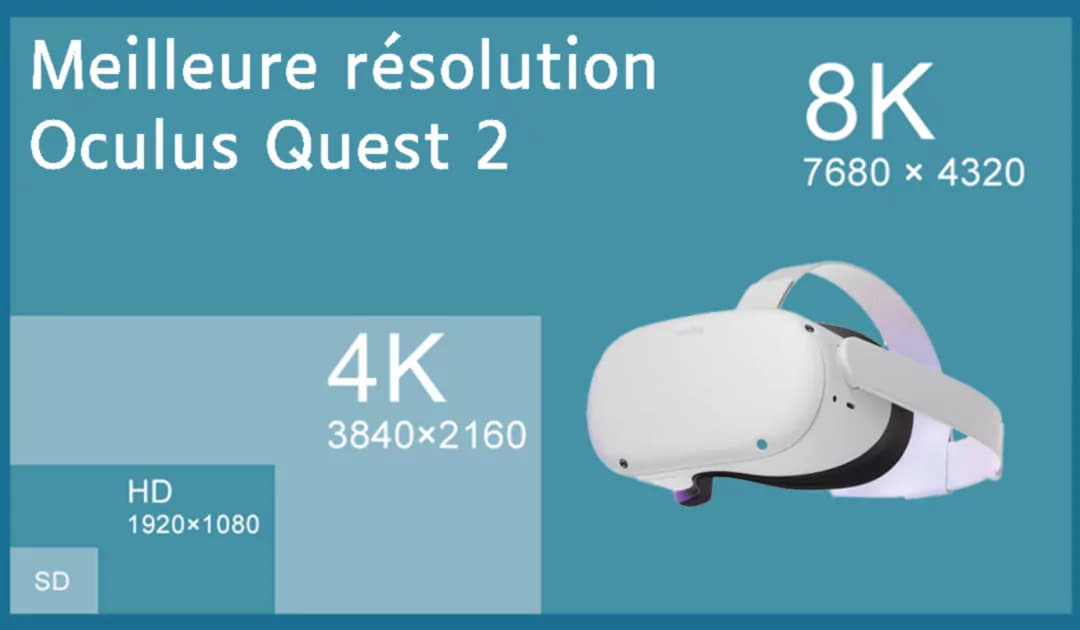
Recommended resolutions
Monoscopic 360° video
Monoscopic video (2D spherical) is the most common format for 360° experiences. The Quest 2 excels in this area.
| Parameter | Recommended | Maximum |
|---|---|---|
| Resolution | 5760 × 2880 | 8192 × 4096 |
| Framerate | 30-60 FPS | 60 FPS |
| Codec | H.265 (HEVC) | H.265 (HEVC) |
| Bitrate | 50-80 Mbit/s | 100 Mbit/s |
Stereoscopic 360° video (3D)
Stereoscopic video provides depth perception through two distinct images (one for each eye). The Quest 2 handles this demanding format very well.
| Parameter | Recommended / Maximum |
|---|---|
| Resolution | 5760 × 5760 |
| Framerate | 60 FPS |
| Codec | H.265 (HEVC) |
| Format | Top-Bottom or Side-by-Side |
| Bitrate | 100 Mbit/s |
180° Side-by-Side video
The 180° VR format is ideal for front-facing content with a depth effect.
| Parameter | Maximum |
|---|---|
| Resolution | 5760 × 5760 |
| Framerate | 60 FPS |
| Codec | H.265 (HEVC) |
| Bitrate | 100 Mbit/s |
Why choose H.265 on Quest 2?
Unlike the Pico G2 4K, the Meta Quest 2 is optimized for the H.265 (HEVC) codec thanks to its XR2 processor:
- Better compression: smaller files at the same quality level
- Higher resolutions: supports up to 8K
- Optimized hardware decoding: the XR2 decodes H.265 natively
- Smooth 60 FPS: even at high resolutions
Quest 2 technical specifications
- Processor: Snapdragon XR2 (first generation)
- Display: 3664 × 1920 total (1832 × 1920 per eye), single LCD panel
- Refresh rate: 72 to 120 Hz depending on the application
- Codecs: H.264, H.265 (HEVC) and VP9; no hardware AV1 decoding
- Maximum video decoding: 8192 × 4096 at 60 FPS in H.265
Resolution vs Performance
- Better battery life: lower power consumption
- Less overheating: extended comfort for the user
- Smoother playback: stable framerate without drops
- Equivalent experience: the visual difference is often imperceptible
For extended sessions (training, exhibitions), prefer 5K@30FPS over 8K@60FPS.
Recommended export settings
Here is a summary of the optimal settings for exporting your 360° videos on Quest 2:
| Parameter | Value |
|---|---|
| Resolution | 5760 × 2880 (mono) / 5760 × 5760 (stereo) |
| Framerate | 30-60 FPS |
| Video codec | H.265 (HEVC) |
| Profile | Main 10 |
| Bitrate | 50-80 Mbit/s (VBR recommended) |
| Audio codec | AAC, 48 kHz, stereo or ambisonic |
| Container | MP4 |
Tips to optimize your videos
Take advantage of 60 FPS
The Quest 2 handles 60 FPS at high resolution: make the most of it for sequences with camera movement, where smoothness makes a real difference to visual comfort.
Spatial audio
The recommended resolution of 5760×2880 leaves enough processing headroom for ambisonic audio. Feel free to incorporate spatial sound to enhance immersion.
Streaming vs local
- Streaming: bitrate is limited (~32 Mbit/s in H.264). Prefer local download for the best quality.
- Local: you can leverage the full potential (100 Mbit/s H.265)
Production workflow
- Shooting: film at the maximum resolution of your 360° camera
- Editing: work in your native resolution
- Export: apply the recommended settings above
- Metadata injection (optional): use the Google Spatial Media Metadata Injector tool so the video is recognized as 360°.Not required for easystory360.
- Test on headset: verify the final rendering on the Quest 2
- Upload to easystory360: integrate your video into your experience