

Explanation
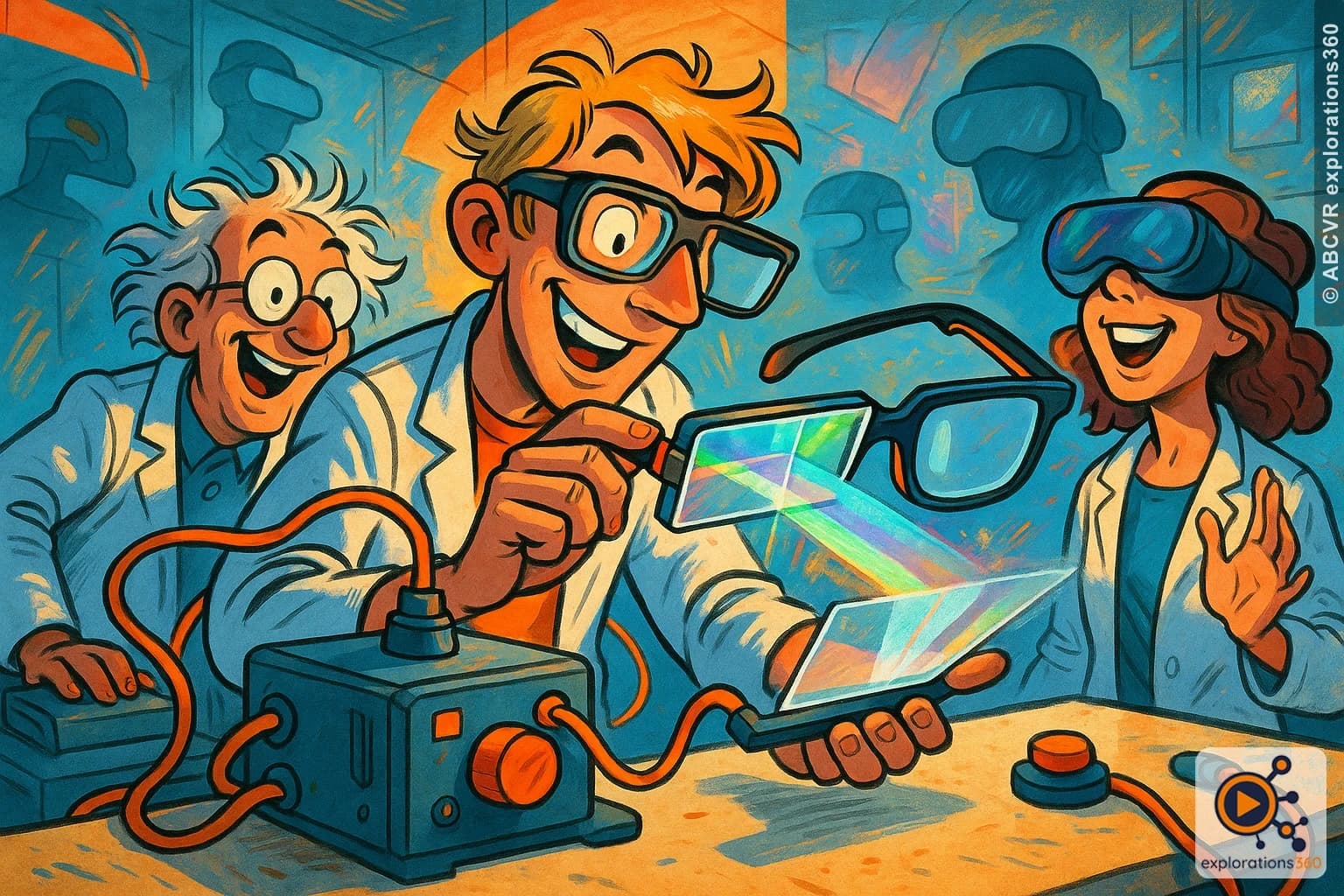
A waveguide is a transparent optical component that captures light emitted by a micro-display, transports it through internal reflections within a thin glass layer, then projects it toward the user's eye. It is the key technology enabling AR glasses to display digital images while remaining transparent. Unlike VR headset optics (pancake, Fresnel), the waveguide must let the real-world view pass through.
Real-world example
Microsoft's HoloLens 2 uses waveguides to project holograms into the field of view while allowing the user to see the real environment through the lenses.
Practical applications
- AR glasses: displaying information in the field of view without blocking reality
- Field assistance: instructions and diagrams overlaid on the real world via waveguide
- Navigation: direction arrows projected in front of you as you walk
- Translation: real-time subtitles in the field of view
Types of waveguides
Diffractive waveguide
- Nanoscale gratings etched into glass
- Good image uniformity
- HoloLens 2, Magic Leap 2
Example: Microscopic diffraction gratings redirect light toward the eye
Reflective waveguide
- Stacked semi-reflective mirrors
- Good contrast and brightness
- Lumus, some military eyewear
Example: Internal mirror layers project the image through successive reflections
Holographic waveguide
- Holographic films to guide light
- Ultra-thin, strong aesthetic potential
- In R&D at several manufacturers
Example: Goal: AR lenses indistinguishable from regular glasses
VR scenario
A maintenance technician wears waveguide AR glasses on an industrial site. Wiring diagrams are displayed directly on the electrical panel they are looking at. They see both the real world and digital annotations simultaneously, hands-free. The lenses look like ordinary glasses - their colleagues notice nothing.
Why it matters in professional VR
- The waveguide is the critical technology for thin, lightweight AR glasses
- Waveguide quality determines FOV, brightness, and transparency
- It is the main technological challenge for consumer AR glasses
- Waveguide advances drive the transition from VR (headset) to AR (glasses)