

Explanation
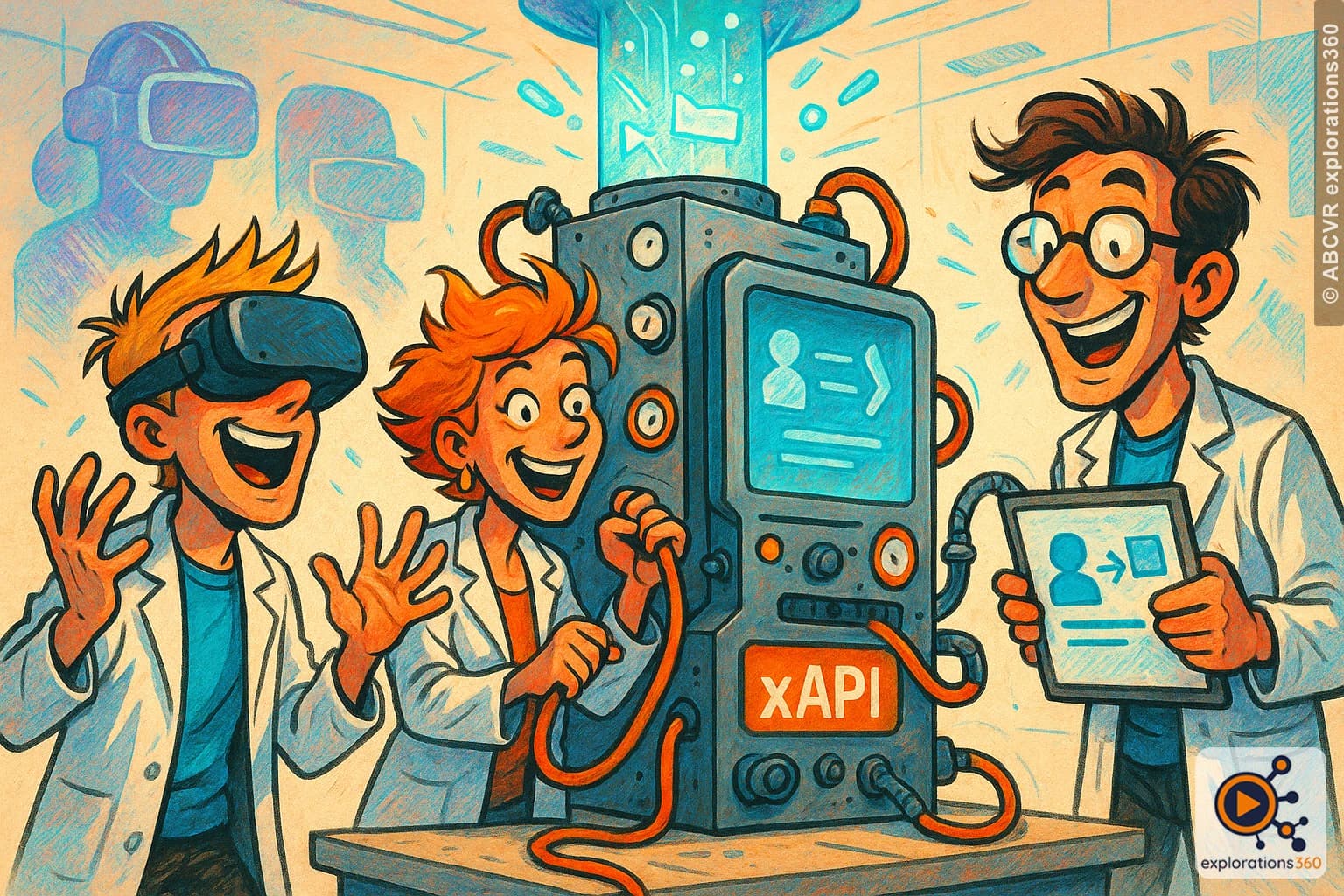
xAPI (Experience API), also known as Tin Can API, is the modern successor to SCORM for learning analytics. Unlike SCORM, which only works within a web browser and an LMS, xAPI can track learning experiences anywhere: in VR, on mobile, in-person, or offline. Each interaction is recorded as a JSON statement: "Marie completed the VR safety module with a score of 85%". These statements are sent to an LRS (Learning Record Store) which can be connected to the LMS. In immersive contexts, xAPI is particularly valuable because it can track data impossible with SCORM: gaze direction in VR, interactions with 3D objects, time spent in each zone of a 360° scene, and navigation paths between scenes. EasyStory 360 supports xAPI to send interaction data to any compatible LRS.
Real-world example
During a VR training pathway on EasyStory 360, xAPI records that the learner looked at the danger zone for 12 seconds, clicked on the fire extinguisher, answered the quiz correctly, and completed the module in 8 minutes -- all this data flows into the LRS.
xAPI vs SCORM
Advantages of xAPI over SCORM
- Gaze tracking and VR interactions (impossible with SCORM)
- Works offline with later synchronization
- Not limited to a single LMS -- data goes to a shared LRS
Example: A learner in a disconnected VR headset completes a training pathway; upon reconnection, all xAPI statements are sent to the LRS
xAPI ecosystem
- Activity Provider: EasyStory 360 generates xAPI statements during VR experiences
- LRS: Learning Locker, Watershed, or the LRS built into the LMS
- Analytics: progress dashboards, heatmaps, certification reports
Example: EasyStory 360 (Activity Provider) sends statements to Moodle's LRS, which displays progress in the gradebook