

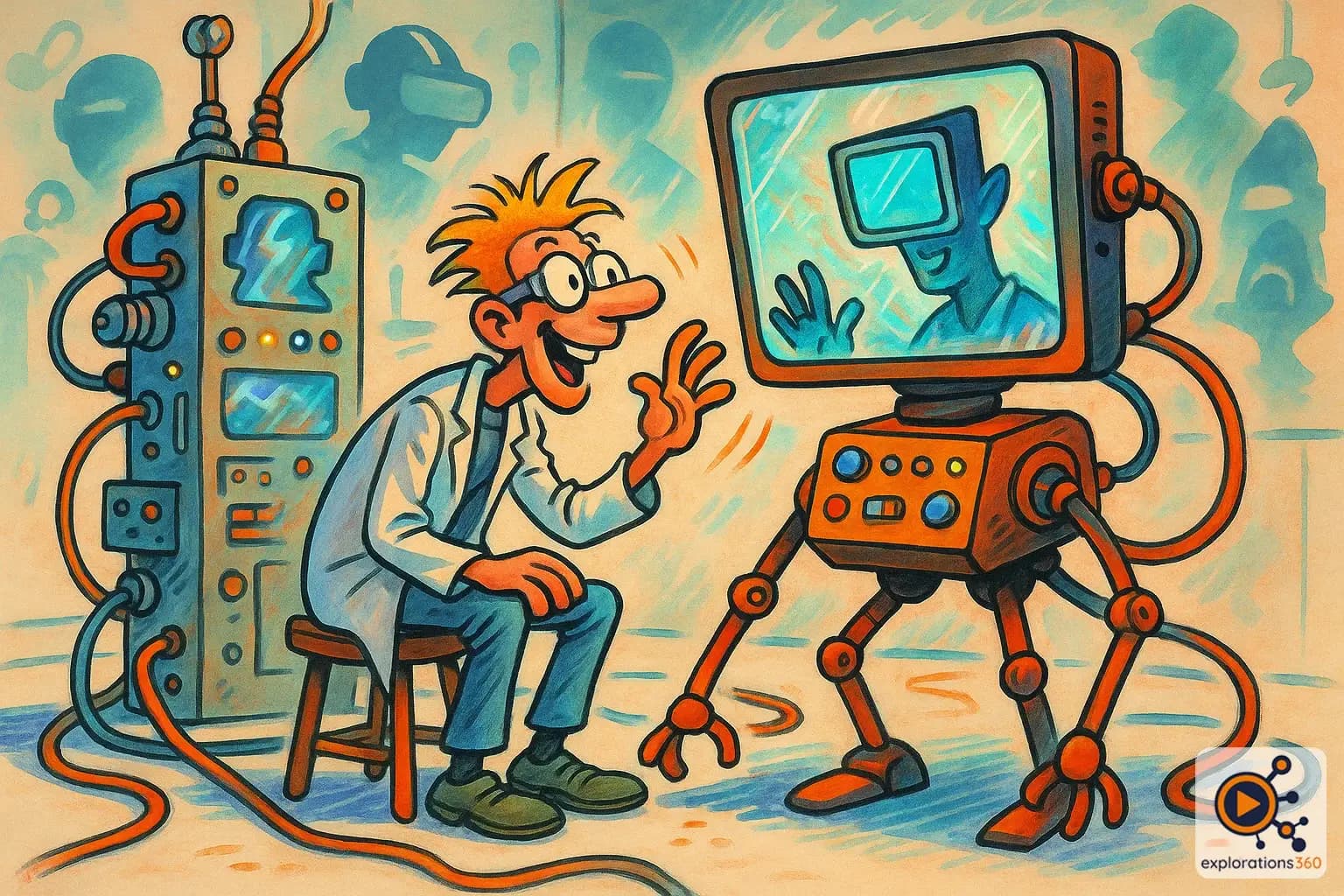
Explanation
The feeling of being physically present in a remote location through technology.
Real-world example
Joining a VR meeting and feeling as though you are actually in the room.
Practical applications
- Immersive meetings: virtual presence superior to video conferencing
- Remote assistance: an expert who "sees" and "acts" on a distant site
- Site visits: exploring a location on the other side of the world as if you were there
- International collaboration: distributed teams working "together"
Levels of telepresence
Audio/video telepresence (Teams, Zoom)
- See and hear your colleagues
- A window onto the other location
- No feeling of "physical presence"
Example: A standard video call
VR/AR telepresence
- Avatars or volumetric video feeds
- Feeling of being in the same space
- Spatial interactions (pointing, moving around)
Example: A meeting in Horizon Workrooms
Teleoperation (robots/drones)
- Remote control of a robot
- Seeing through its "eyes," acting with its "hands"
- Industrial and medical applications
Example: A surgeon operating via robot thousands of kilometers away
VR scenario
An expert based in Paris diagnoses a problem on a machine in Singapore. Via an MR headset, they "see" the equipment through the eyes of the local technician, can annotate the space (arrows, circles), and guide the intervention as if they were on site.
Why it matters in professional VR
- VR/AR telepresence reduces costly and time-consuming travel
- Measurable ROI: transportation savings, faster response times, reduced carbon footprint
- Mature use case in technical support and international collaboration