

Explanation
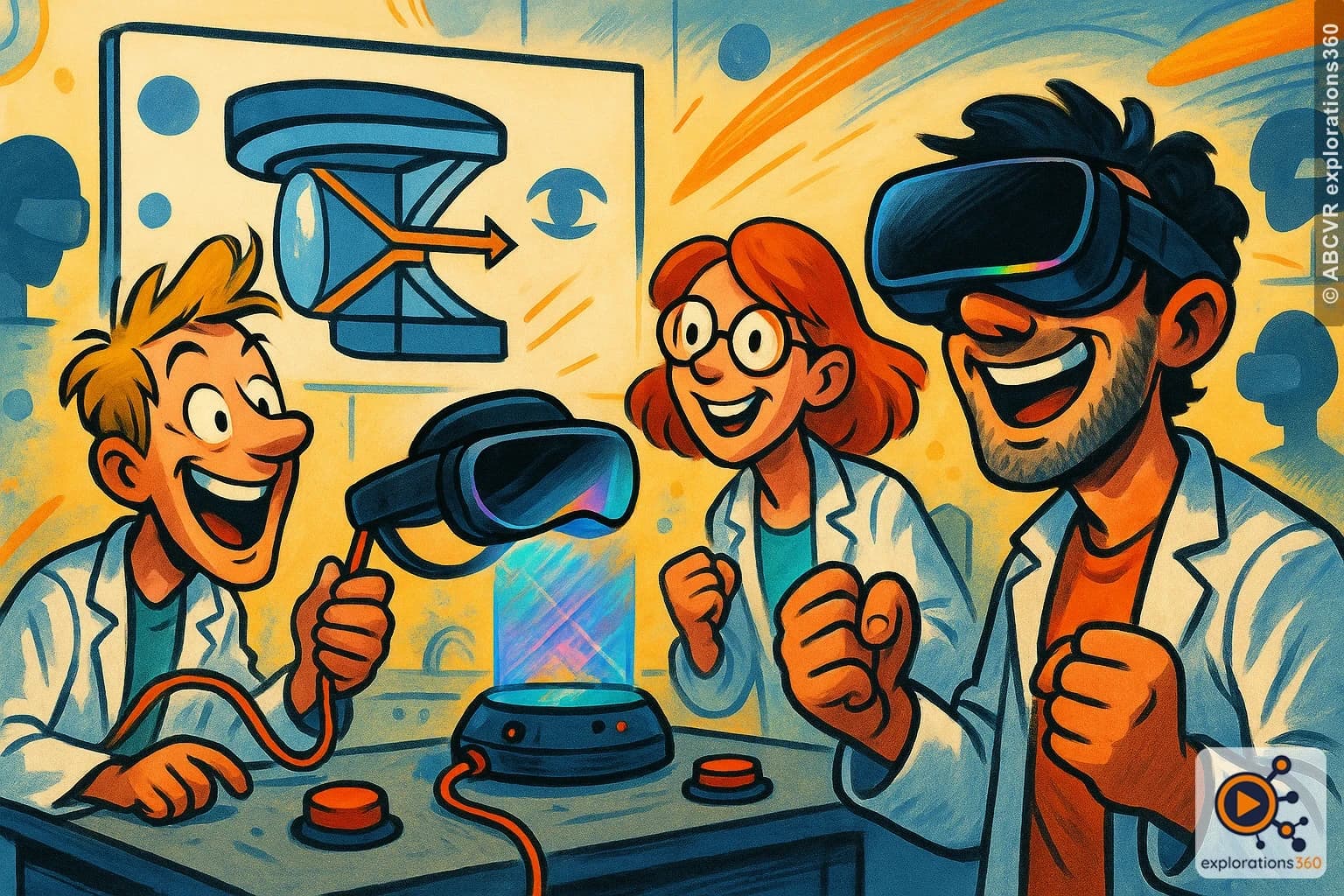
Pancake lenses use a polarization and internal reflection system to fold the light path multiple times between the display and the eye. The result: optical thickness drops from 40-50 mm (traditional Fresnel lenses) to 20-25 mm. This is the technology that enabled recent headsets (Meta Quest 3, Apple Vision Pro, Pico 4) to be significantly thinner and lighter than their predecessors.
Real-world example
The Meta Quest 3 is 40% thinner than the Quest 2 thanks to pancake lenses, while offering a similar field of view.
Practical applications
- Comfort: lighter headsets that sit more balanced on the head
- Aesthetics: slimmer profile, less of the bulky headset stigma
- Image quality: better edge-to-edge sharpness than Fresnel lenses
- Adoption: comfort encourages longer sessions in training or work
Headset optics comparison
Fresnel lenses (previous generation)
- Thick but lightweight and affordable
- Visible artifacts (god rays)
- Quest 2, Valve Index, PSVR
Example: The light halos visible in dark scenes on the Quest 2
Pancake lenses (current generation)
- Compact, high optical quality
- Heavier than Fresnel (glass elements)
- Quest 3, Vision Pro, Pico 4
Example: Sharp image all the way to the edges on the Meta Quest 3
Future optics (metalens, holographic)
- Ultra-thin, potentially suitable for AR glasses
- Still in research, not yet in production
- Promise of AR glasses as thin as regular eyewear
Example: Holographic lens prototypes at Meta Reality Labs
VR scenario
A trainer compares the Quest 2 and Quest 3 for 2-hour sessions. With the Quest 2 (Fresnel), learners complained about weight and light halos. With the Quest 3 (pancake), the headset is slimmer, the image sharper, and sessions end without visual fatigue.
Why it matters in professional VR
- Pancake lenses have made VR headsets acceptable for extended use
- The most impactful optical innovation since Fresnel lenses
- Trade-off: they absorb more light, requiring brighter displays
- A key step toward ever thinner and more comfortable headsets