

Explanation
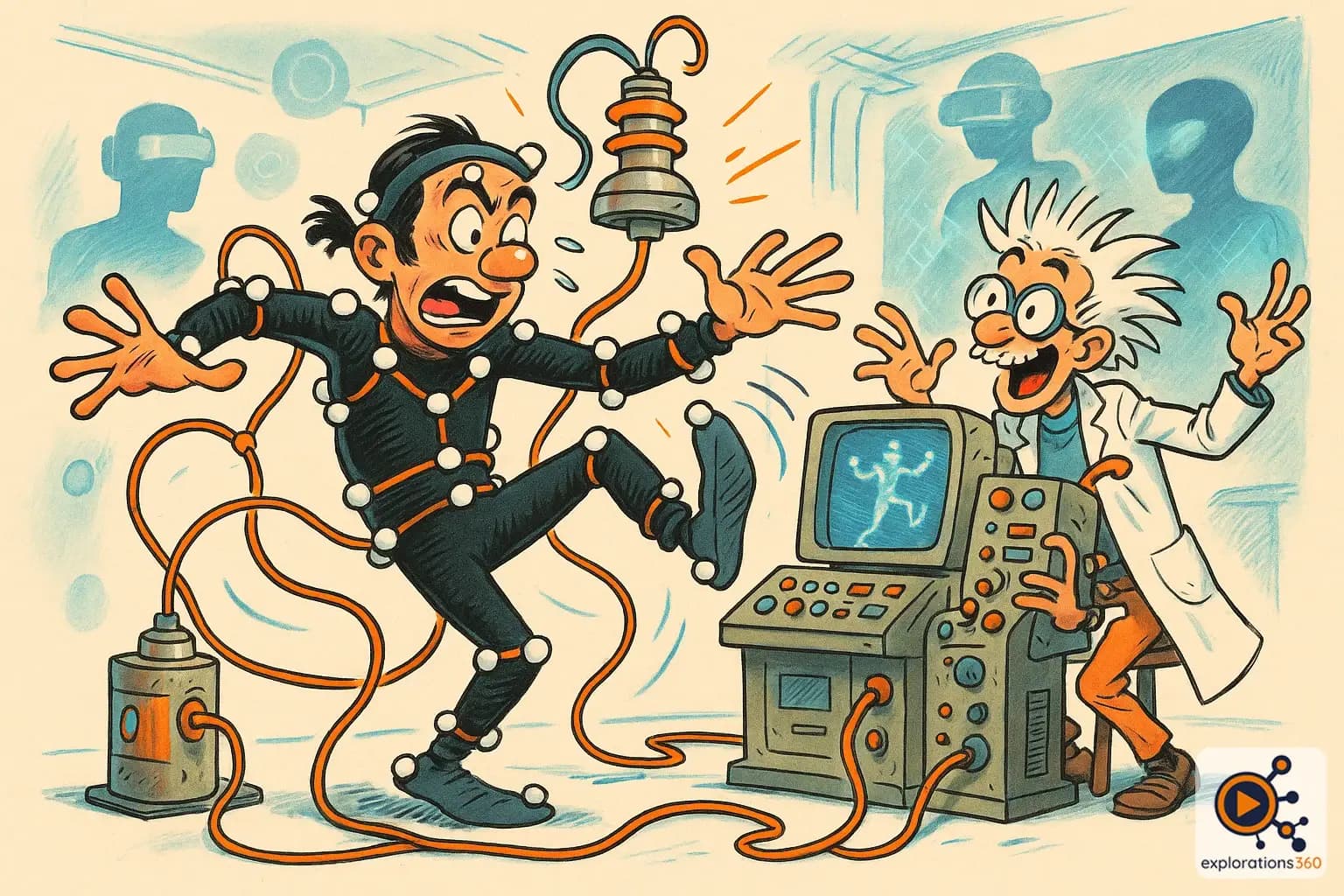
A technology that records body movements and reproduces them digitally, enabling realistic animation of virtual characters and analysis of physical gestures.
Real-world example
The motion capture suits covered in reflective markers used to create Gollum in The Lord of the Rings.
Practical applications
- Character animation: creating realistic movements for avatars and 3D characters
- Gesture analysis: studying and correcting the movements of athletes, operators, or dancers
- Gesture-based training: recording expert gestures for knowledge transfer
- VR content creation: producing natural animations for immersive experiences
Mocap technologies
Optical capture (markers)
- Reflective markers placed on the body
- Infrared cameras in the room
- Very high precision, standard for cinema and AAA games
Example: OptiTrack, Vicon studios for films and video games
Inertial sensor capture (IMU)
- Suit with accelerometers/gyroscopes
- No external cameras needed
- More portable, less precise
Example: Xsens, Rokoko motion capture suits
Vision-based capture (markerless)
- AI analyzing standard video footage
- No equipment worn by the actor
- Accuracy improving rapidly
Example: Solutions based on pose estimation (MediaPipe, etc.)
VR scenario
A subject matter expert performs a complex technical gesture (welding, surgical manipulation). Their movements are captured and integrated into a VR training module. Learners can replay the gesture, view it from every angle, and compare their own execution to the expert's.
Why it matters in professional VR
- Mocap enables the creation of VR content with believable human animations
- A key tool for gesture-based training: capturing expertise for transfer
- Costs are decreasing: solutions accessible to SMEs, no longer limited to AAA studios