

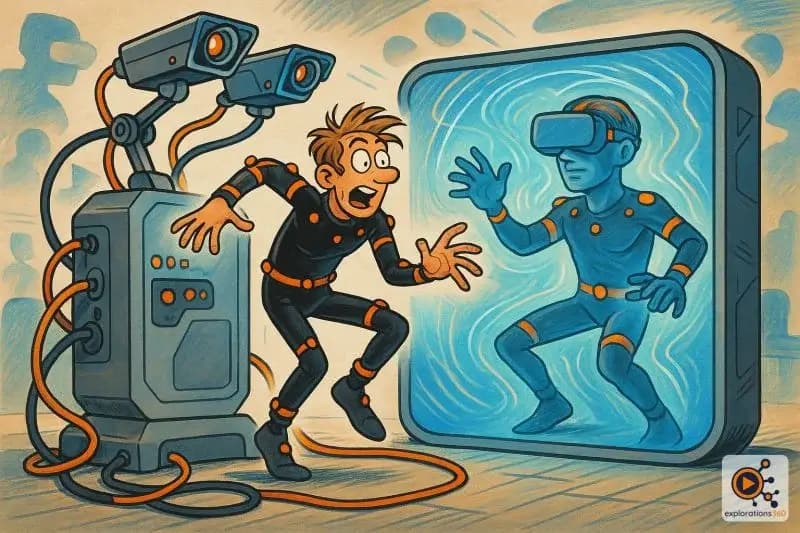
Explanation
The state of being completely absorbed in an artificial environment.
Real-world example
Being so focused in a game that you forget the real world around you.
Practical applications
- Maximum engagement: the user is "cut off" from external distractions
- Accelerated learning: the brain processes the virtual experience as if it were real
- Authentic emotional responses: stress, excitement, empathy... all amplified
- Enhanced memory: immersive experiences are retained better
Immersion factors
Sensory immersion
- Visual: wide FOV, high resolution, stereoscopic 3D
- Audio: spatialized 3D sound, isolating headphones
- Haptic: vibrations, force feedback
Example: A high-end headset with built-in audio and haptic controllers
Cognitive immersion
- Engaging narrative, clear objectives
- Logical and natural interactions
- Absence of elements that "break" the illusion
Example: A training scenario where every action has meaning and consequence
VR scenario
In a crisis management simulation, the manager is immersed in a virtual open-plan office in an emergency situation. Their stress rises for real, and decisions are made "in the heat of the moment." This immersion allows the evaluation and training of soft skills that would be impossible to practice otherwise.
Why it matters in professional VR
- Immersion is what differentiates VR from all other media — it is its unique value proposition
- In training, immersion enables "learning by doing" in scenarios that are otherwise inaccessible
- The quality of a VR experience is measured by its ability to sustain immersion without breaking it