

Explanation
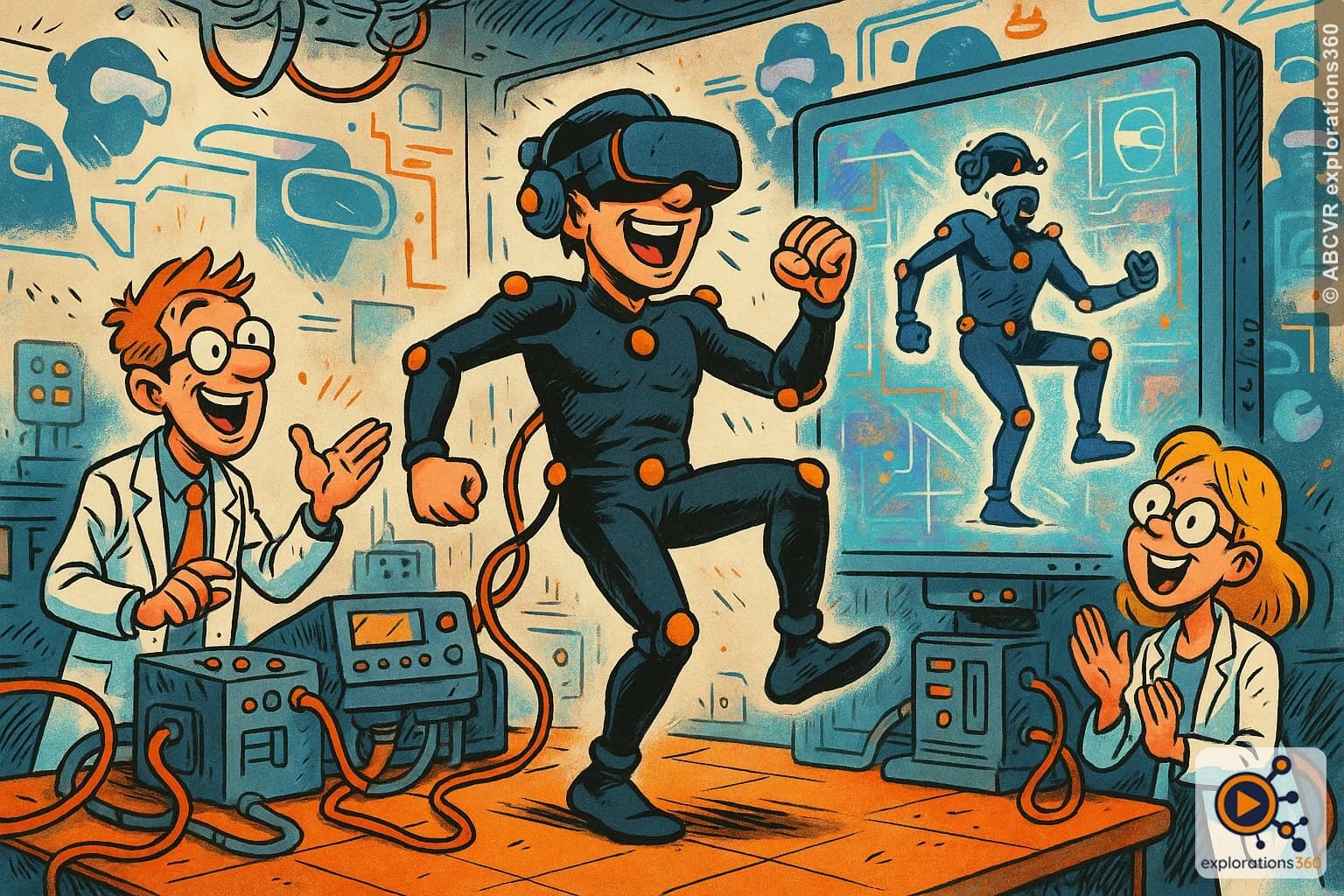
Full Body Tracking (FBT) goes beyond head and hand tracking: it captures the position and orientation of the torso, arms, legs, and feet using additional sensors (body-worn trackers, motion capture suits, or AI-based estimation via the headset's cameras). The result: a virtual avatar that faithfully reproduces the user's full posture and movements, making VR interactions much more natural and expressive.
Real-world example
A dancer wears trackers on their feet and waist in addition to a VR headset: their avatar reproduces every dance step in real time in a virtual world.
Practical applications
- Professional gesture training: capturing a technician's full posture to evaluate safety gestures
- Social VR and expressive avatars: walking, sitting, crossing arms - the avatar reproduces all body language
- Performance and entertainment: dancers, actors, and artists drive avatars live
- Sports and rehabilitation: analyzing the complete biomechanics of a patient or athlete in immersion
Body tracking technologies
External trackers (Vive Trackers, Pico Trackers...)
- Small sensors attached to the body (feet, waist, elbows...)
- High accuracy, low latency
- Compatible with SteamVR or manufacturer SDKs
- Require additional equipment to wear and charge
Example: 3 Vive Trackers (waist + 2 feet) turn a standard VR headset into a full body system
AI-based estimation (camera-based)
- Headset cameras estimate limb positions using AI
- No additional accessories to wear
- Less precise than physical trackers but improving rapidly
- Built into the latest headsets (Quest 3, Pico OS 6)
Example: The Quest 3 estimates your leg positions via AI to animate your avatar, without any trackers
VR scenario
A construction company uses full body tracking for VR safety training. The technician wears a headset and 3 trackers (waist and feet). During the simulation, the system analyzes their complete posture: are they positioned correctly to lift a load? Are their feet properly spaced? Are they bending correctly? The avatar reproduces every movement and the trainer can correct gestures in real time.
Why it matters in professional VR
- Full body tracking makes VR avatars realistic and expressive, essential for social and collaborative VR
- In professional training, it enables evaluation of full posture and gestures, not just hands
- Advances in on-device AI (camera-based estimation) will democratize FBT without additional accessories
- Pico OS 6, SteamVR, and other platforms natively support body trackers via OpenXR